Marketing for the animals: activism on the Autobahn

TL;DR: A German logistics company decorated its fleet of trucks with animal rights messaging, and Ethical Brand Marketing helped design one for Doctors Against Animal Experiments. This is what marketing for the animals looks like in real life: bold, visible, and impossible to ignore at 130 km/h.
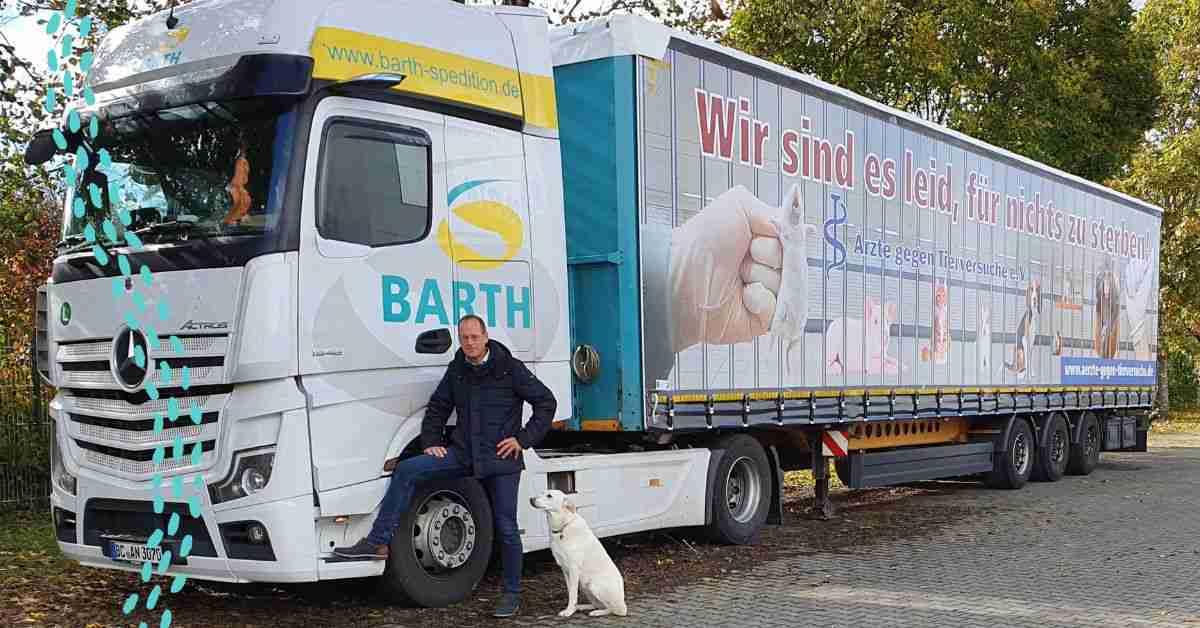
Marketing for the animals means using your creative and professional skills to advocate for species that can’t speak for themselves. In 2021, I helped design a campaign truck for Doctors against Animal Experiments, a German advocacy organization working to end animal testing. The truck carried a simple, confrontational message across highways in Germany, Austria, and Switzerland: “We’re sick of dying for nothing!”
What does purpose-driven business as usual look like?
Purpose-driven business as usual means weaving your values into your operations so completely that your brand becomes the message. Markus Barth, owner of Barth Spedition, a logistics company in Germany, has done exactly that. A vegan since 2010 and vegetarian for 11 years before that, he’s been using his fleet of trucks as moving billboards for animal welfare for over two decades.
Meet Nelly, a sweet labrador mix rescue, and Markus himself, presenting his newest 12-wheeler to spread awareness about the useless experiments performed on animals.
This isn’t his first truck. His fleet consists of 50 trucks and 70 trailers. Of those, 60 carry animal-friendly messages. He’d be happy to cover the last 10 too, so if your organization has a message to spread across Germany, Austria, and Switzerland, reach out to him directly.
What happens when a massive machine with images of poorly treated farm animals drives by with a message from Animals’ Angels that reads: “Stop transporting animals!” Or a campaign from the Albert Schweitzer Stiftung that asks: “Who to pet, who to eat?” showing a dog and a pig side by side?
Drivers get a thumbs-up. Conversations start at rest stops. And in 2008, Markus Barth Logistik GmbH & Co. KG was awarded “Animal Friendliest Trucker” by PETA.
Animal activism runs in his family, too. His wife, Inge Barth, runs her own vegan business, Inge’s Kitchen, offering cooking courses and recipes.
For those about to protect animals, we salute you!
How did this campaign for lab animals begin?
This campaign started with a single truck and a Gandhi quote. One of Markus Barth’s earlier designs featured a photo of an adorable baby seal cub alongside Mahatma Gandhi’s words:
“I hold that the more helpless a creature, the more entitled it is to protection by man from the cruelty of humankind.”
Claus Kronaus, Managing Director of Ärzte gegen Tierversuche e.V. (Doctors Against Animal Experiments), spotted that truck about three years before we worked together. He immediately knew he wanted his own design. Sometimes turning a dream into a reality takes time.
With the help of Markus Barth and generous supporters of the organization, the time came. And that’s where Ethical Brand Marketing came into the mix, because marketing for the animals is exactly why we’re here.
My connection to this cause
As a member of Doctors against Animal Experiments and author of Lily Bowers and the Uninvited Guest, an eco fantasy that addresses animal testing in a child-friendly way, I wanted to give a small gift to every new member. So we launched our first campaign together in April 2021.

My middle-grade book came out on April 24, 2019, the International Day for Laboratory Animals, with the organization’s link printed inside so readers could back their work.
I was then personally invited to support the organization in Cologne during their annual protest on April 24, 2021: the International Day for Laboratory Animals. I had the opportunity to interview their geneticist and scientist Dilyana Filipova in both English and German, and donate my ebook to every new member in April and May.
In 2021 the organization interviewed me about the book for its journal. My interview with Dilyana was the return.

Photo credit: © Ernst Drews
After getting to know the team, it was clear we’d work together again. In June, we began talking about the truck. I was asked if I wanted to design it. Absolutely.
Why does animal testing put human health at risk too?
Animal testing isn’t just an animal welfare issue. It’s a human health problem. I used to view it purely on ethical grounds, thinking more about the lab animals than the supposed advantages for humans. I still hold that position. And now I also know the science backs it up.
The failure rate for translating animal test results into human treatments remains above 92%, according to a Johns Hopkins narrative review published in the journal Alternatives to Laboratory Animals. The majority of those failures are due to unexpected toxicity, meaning safety issues that animal tests simply didn’t catch.
More than 90% of drugs that appear safe and effective in animals fail in human trials, according to a 2025 analysis published in STAT News by a 30-year drug development researcher. That’s not a fringe claim. It’s the consensus concern driving regulators to look for better models.
We’re not beagles, cats, mice, guinea pigs, or zebrafish. The biological differences matter enormously. That’s why we have so many drug side effects. That’s why treatments for HIV, Alzheimer’s, and stroke have repeatedly shown promise in animal models and then failed completely in humans. And that’s why, as a 2024 review in Frontiers in Drug Discovery notes, predicting drug efficacy via animal models is “scarcely better than a coin flip.”
The answer to why this continues is, as it so often is: money. There are scientists and businesses with a financial stake in the current system. It’s big business. You can read more about the truth about animal testing on my author website.
What the public actually thinks
Public opinion has shifted significantly. A 2026 survey by Savanta for Eurogroup for Animals, covering 18,227 adults across 18 EU member states, found that:
- 70% agree that enabling the full replacement of animal testing with non-animal methods should be an EU priority
- 66% agree the EU should immediately end all animal testing
That’s not a niche position. That’s a majority. And it’s growing.
How do you design a message people absorb at 130 km/h?
Designing for the German Autobahn means designing for speed. There’s not much reading happening when cars are flying past at 130+ km/h with no speed limit in sight. The message has to land instantly.
I thought about how to present the truth about animal testing in as few words as possible. I’m not a doctor. I came to this from an ethical standpoint, thinking about the animals first. And after doing deep research for my book and learning from the Doctors against Animal Experiments team, I understood the human relevance too.
Typical lab animals are the same species many of us keep as pets: beagles, cats, rabbits, guinea pigs. We wanted to show them. Behind bars. Imprisoned and not happy. It’s hard not to feel something when you recognize your own pet in that image.
This also connects to something the FBI has documented:
“Understanding the correlation between animal cruelty and violence brings law enforcement one step closer to saving the lives of both animals and humans.”
In the case of animal experimentation, those performing the tests operate within a legal framework that permits what most people, if they saw it, would call cruelty.
“If only people knew the truth,” I thought. And that’s how the headline was born: “We’re sick of dying for nothing!”
The final design

Photo credit: © Markus Barth
For supporting information, we added the organization’s URL. On the rear of the truck, the team wanted one final message: “Medical progress is important — animal testing is the wrong way!” with a clear call to action: “Help us!”
After a few rounds of optimization, the final design went to Lorenz Planen eGbR, the printer and the truck was ready to roll.


Photo credit: © Lorenz Planen eGbR
What kind of response did the truck get?
The truck launched in mid-October 2021 and the response was immediate. Posts on Instagram and Facebook were well received and generated real engagement.
Claus Kronaus, CEO Finance of Doctors Against Animal Experiments, says reactions to the truck were and still are consistently positive. The donation-doubling campaign in December 2021 was the most successful of its kind up to that point.
For me personally, it was simply incredible to be given this chance to spread our message, or rather, the animals’ message.
Claus Kronaus
CEO Finance, Doctors Against Animal Experiments
What Markus Barth shared when I asked him about the overall shift over the years is worth noting. Twenty years ago, people laughed a little. Then they went quiet. And starting around five years ago (in 2021), they now cheer.
More and more people are becoming aware of social injustices. And they celebrate those who speak up.
That shift isn’t just anecdotal. It reflects a broader cultural movement. Each truck print lasts up to seven years, and when it needs renewing, it gets reprinted. The message keeps traveling.
Where does the fight to end animal testing stand in 2026?
Progress is real, and it’s not nearly fast enough. Here’s where things stand.
In September 2021, the European Parliament voted 667 to 4 in favor of a plan to phase out animal experiments completely. That vote was not legally binding, yet it triggered a requirement for the European Commission to develop an EU-wide action plan with milestones and timelines for replacing animal testing with non-animal, human-relevant methods.
Since then, the 2024 EURL ECVAM Status Report from the EU Science Hub shows a 5% overall reduction in animal procedures in the EU and Norway between 2018 and 2022. A roadmap for phasing out animal testing in chemical safety assessments is due to be published in 2026.
That’s progress. And at the current rate of roughly 1% reduction per year, Cruelty Free Europe calculates it would take until around 2126 to reach zero. That’s not acceptable.
The movement is growing. A second European Citizens’ Initiative calling for an end to animal testing gathered over 1.4 million signatures. Humane Society International/Europe called it a strong signal that European citizens are ready for substantive legislative change.
What can you do right now?
- Sign petitions in your area calling for a complete ban on animal testing
- Support organizations like Doctors against Animal Experiments
- Spread awareness on your social media channels
- Vote for politicians who actively make decisions to protect animals
- If you spot this truck on the road, take a photo (only if you’re not driving!) and send it to me
“I abhor vivisection with my whole soul. All the scientific discoveries stained with innocent blood I count as of no consequence.” ~ Mahatma Gandhi
Use your creative talent to become a voice for the animals
If you’re a nature-led founder, a creative, a consultant, or anyone with a platform, you already have what it takes to market for the animals. You don’t need a fleet of trucks. You need clarity, courage, and the willingness to use your skills for something bigger than your brand.
That’s what ethical marketing looks like in practice. It’s not just about your business. It’s about what your business stands for, and who it stands up for.
If you want to explore what values-aligned messaging and ethical marketing strategy could look like for your work, start there.
Ready to work on a marketing campaign?
I work with a small number of clients at a time. If you’re ready to grow with clarity and intention, apply here and I’ll review your application personally.

About the author
Jessica Lohmann, an ethical marketing strategist since 1991 across agencies, in-house roles, and independent consulting. Connect with her on LinkedIn. With a deep commitment to animal welfare, she helps purpose-driven founders communicate their impact with clarity and integrity. She’s also an animal welfare author and voice talent, and a member of Doctors against Animal Experiments. See how she guides nature-led brands.